CRE Brokers: The Worst Assumption You Can Make
The Assumption Costing You Real Money
One of my mentors, the late and great Ralph Spencer, used to warn me about a trap that quietly drains commissions from otherwise talented commercial real estate brokers.
He called it subconscious competence.
Not conscious competence.
Not incompetence.
But something far more dangerous.
Since Ralph passed, I’m reminded of this idea constantly when working with our coaching clients. Because this same assumptive error still lives large in the brokerage landscape.
And if you’re making it, you’re likely leaving tens of thousands, if not
hundreds of thousands of commission dollars on the table.
Here’s the assumption:
You assume your clients and prospects understand what you understand.
The Four Stages of Competence (And Where Most Brokers Get Stuck)
Psychology outlines four stages of competence that apply to learning any skill:
- Unconscious Incompetence
- Conscious Incompetence
- Conscious Competence
- Unconscious Competence
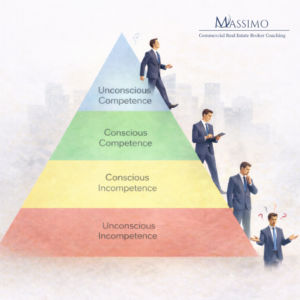
Most brokers think the goal is to reach stage four.
And technically, they’re right.
But in commercial real estate, that’s also where the danger begins.
Why Unconscious Competence Becomes a Liability in CRE
Unconscious competence means you’ve done something so many times that it feels obvious. You no longer think about it, explain it, and slow down for it.
And that’s exactly the problem.
At this stage, brokers stop articulating their value because the work feels “basic” to them.
They skip steps in conversations, jump to conclusions, and assume alignment that doesn’t exist.
Not because they’re careless, but because they’ve forgotten what it’s like not to know.
The Warehouse Problem
Here’s an example Ralph used to give that stuck with me.
Imagine a warehouse specialist who’s spent twenty years in industrial real estate.
She understands:
- Clear heights
- Dock ratios
- Power requirements
- Functional obsolescence
- Tenant improvement economics
To her, it’s second nature.
But she assumes the prospect understands it too, which they don’t.
The client nods politely, says “that makes sense,” and might even agree with the recommendation… but internally, they’re lost.
And when a competing broker takes the time to explain what’s obvious, they win the listing because they made the invisible visible.
How Elite Brokers Turn Competence Into Commission
The highest-performing brokers don’t just have unconscious competence.
They know how to reverse-engineer it.
They intentionally slow down, over-explain, narrate their thinking, and don’t assume understanding.
They build it.
This is why our coaching clients consistently outperform their peers.
They stop asking, “How do I show how much I know?”
And start asking, “What might they not understand yet?”
That single shift changes everything.
A Simple Test You Can Run This Week
Here’s a quick exercise.
In your next client or prospect conversation, pause and ask yourself:
- Am I skipping steps because this feels obvious?
- Am I using language that only brokers understand?
- Am I assuming agreement equals comprehension?
Then do the opposite.
Explain the “basic” thing.
Clarify the assumption.
Slow the moment down.
You’ll feel almost silly doing it.
That’s how you know it’s working.
Because what feels obvious to you is often the very thing your client is paying to understand.