
CRE Brokers: Build Your Dream Team

I will be honest with you. I am not a huge NBA guy.
But with the playoffs starting this month, it is impossible to escape the conversation.
And it got me thinking about the greatest team I ever watched. The Chicago Bulls dynasty of the 1990s.

Phil Jackson built something with Jordan, Pippen, and Rodman that was not just a great basketball team. It was a masterclass in assembling the right people, putting them in the right roles, and executing a system that was better than everyone else’s.
The triangle offense only worked because every single player bought into their specific role and the structure around them. Jordan was the closer. Pippen was the engine. Rodman did the things nobody else wanted to do. Pull any one of those pieces out, and the whole thing collapses.
In commercial real estate, the same principle applies.
If you want to grow to the next level, your results depend on building the right team. Not just hiring people. Building with intention.
Most brokers make hiring mistakes. And in CRE, where timelines are long, stakes are high, and market conditions shift constantly, one bad hire can mean:
Wasted months of your time. Costly cycles of firing and re-hiring. Hundreds of thousands in lost deals and momentum.
Here is what I have learned after hiring hundreds of salespeople, marketers, brokers, coaches, consultants, and administrators over nearly four decades in this industry.
-
Do not hire before you are ready
The Bulls did not hand Rodman a roster spot and figure out his role later. Phil Jackson knew exactly what the team needed before he made the move.
In brokerage, hitting mid-six figures is often about consistently prospecting and closing. But reaching high six- or seven-figure levels requires more than hustle. It requires a platform, processes, and people, in that exact order.
At The Massimo Group, we call this the Operational P Factor.
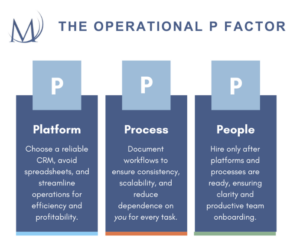
Platform: Your CRM and transaction management system must be solid before you bring anyone on. Pick one and commit to it. Managing deals through sticky notes and spreadsheets is leaving money on the table.
Processes: Define a workflow for everything. Prospecting, client onboarding, listing presentations, and follow-ups. Document how your operation runs so your team can replicate your success without needing your constant input.
People: Only after your platform and processes are in place should you hire. Otherwise, new team members arrive confused, unproductive, and asking the same questions repeatedly.
By prioritizing these three elements, your brokerage can operate efficiently. Smarter hires, better margins, and a stronger client experience.
-
Hire on data, not instinct
Even Phil Jackson did not just go with his gut when building that roster. He studied players, understood their tendencies, and evaluated how each one fit the system before committing.
Too many brokers do the opposite. They meet a candidate, feel a connection, and think it is a fit. That is a surefire way to end up with the wrong person in the wrong role.
Here is a process that works:
Assess, do not guess. Use behavior and skills assessments before extending any offer (see www.creperform.com).
Hire in batches. Whenever feasible, consider onboarding three candidates simultaneously and allow their performance to guide the decision on who remains.
Set a 30-, 60-, and 90-day expectations plan from day one. Every hire should know exactly what success looks like before they start.
Establish clear KPIs. Managing by data removes the emotion from performance conversations and makes your decisions far easier.
And apply this rule without exception: if someone is not on track within 90 days, they will not get there. Have the tough conversation early.
-
Know when to say no
Even the GOAT, Michael Jordan, turned down a lot of shots over his career. Not because he lacked confidence, but because he trusted the system and knew when the right moment was. That discipline is what kept the Bulls clicking.
The same discipline matters in hiring and in leadership.
One of the clients I coach personally is Bob Knakal. Years ago, Bob was generating around six million dollars in annual commissions, well below what his skill set and market position warranted.
When I dug into why, the answer was clear. He said yes to everything. Every client request, every meeting, every opportunity that came across his desk.
I gave him a simple assignment. Say no at least three times a week and track it.
That shift, combined with several other strategies we put in place, helped Bob more than triple his income to over eighteen million dollars within three years.
Saying no is not about being difficult. It is about protecting your time and focusing on the highest-value work.
As a leader, saying no also means the following:
- Not hiring someone just because you are short-staffed.
- Turning down clients who do not fit your ideal profile.
- Eliminating distractions that pull you away from building your business.
The brokers who scale are the ones who stop playing defense. They hire with intention, trust data over instinct, hold their teams accountable from day one, and protect their time as the asset it is.
If you want the exact frameworks, models, and systems used to help new and veteran brokers (and everyone in between) to work fewer hours and gain real freedom, I recorded a 40-minute video walking you through our CRE Broker 7-Figure Blueprint.