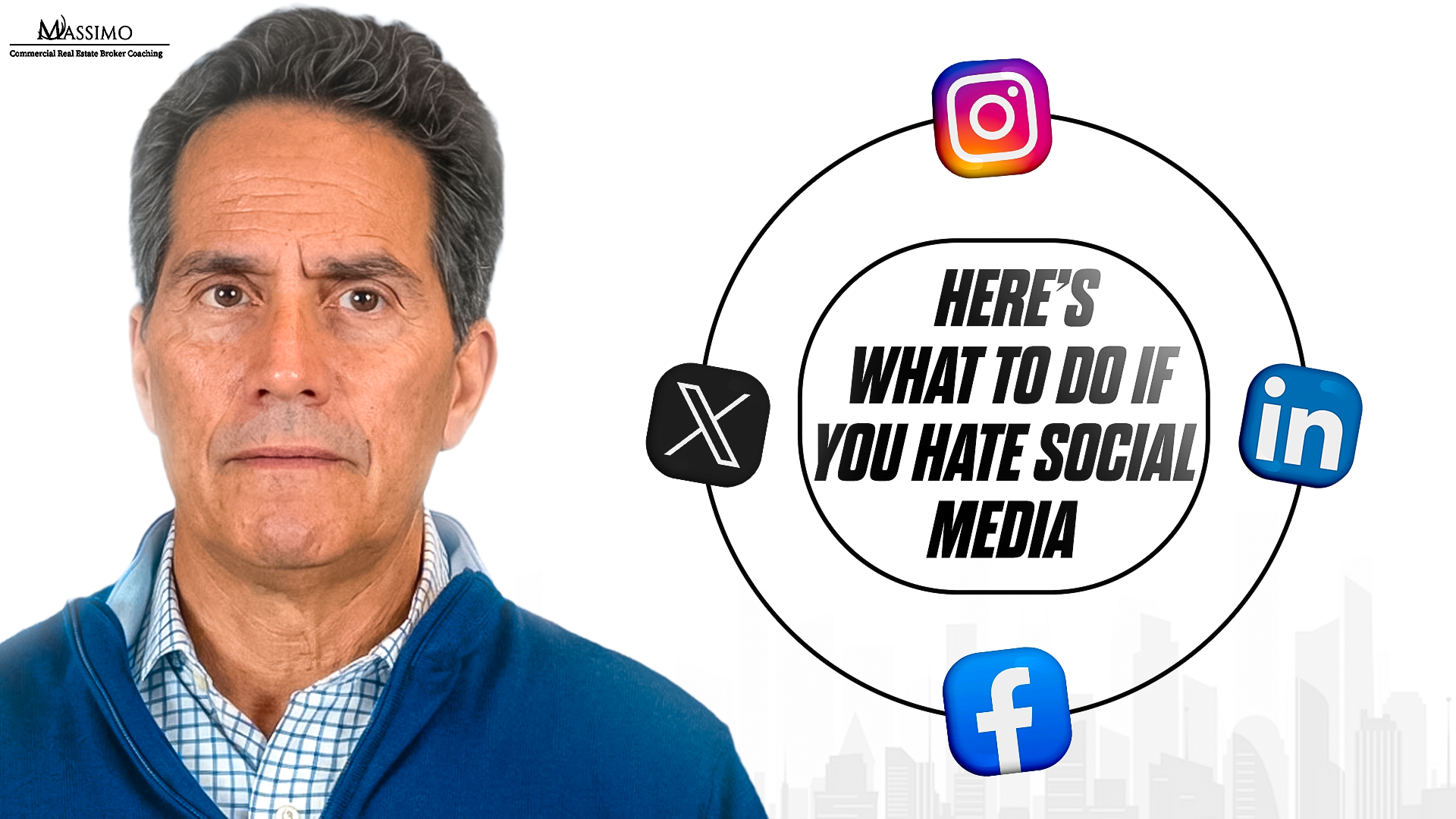
How to Use Social Media in Commercial Real Estate When You Hate Social Media
You can build a useful social media presence in commercial real estate without turning your life into content.
For experienced brokers, investors, leasing professionals, and other commercial real estate experts, a better approach is to treat social media as a distribution channel for professional expertise.
That changes the question.
Instead of constantly wondering what you should post, start thinking about what the tenants, landlords, owners, investors, executives, and other decision-makers you serve would benefit from hearing.
That is the foundation of a much more practical commercial real estate social media strategy.
Why Social Media Feels Wrong to Many Experienced CRE Professionals
A large percentage of social media is built around entertainment, connection, attention, personal updates, and habit.
That may have very little appeal to someone who has spent 15, 20, or 30 years building expertise in commercial real estate.
You may have no interest in posting what you ate.
You may not want to share airport selfies.
You may not want to announce every meeting or manufacture personal stories just to remain visible.
You do, however, have knowledge your market may find extremely valuable.
That is where social media starts to make business sense.
Your objective is not to become more “social.” Your objective is to make your knowledge easier for the right people to discover and consume.
What Is a Better Social Media Strategy for Commercial Real Estate Professionals?
A practical commercial real estate social media strategy turns your existing expertise into useful communication.
That expertise might come from:
- A lease negotiation
- A conversation with an investor
- A mistake you have watched companies make repeatedly
- A change you are noticing in your market
- A client result
- An investment observation
- A strong professional opinion
- A lesson from a transaction
The source material already exists because you are living it every day.
The opportunity is to identify the parts of that experience that have value for someone else.
Rod summarizes the concept particularly well in the video: use your life to illustrate your ideas rather than simply posting your life.
That distinction gives experienced professionals far more useful territory to work with.
Personal Content Can Still Have a Business Purpose
Personal Does Not Have to Mean Trivial
There is a meaningful difference between sharing a personal detail and publishing something with no professional relevance.
Consider a dinner with an investor.
The restaurant itself probably does not matter to your audience.
An observation from the investor that changed how you think about investment decisions might.
The same applies to travel.
Announcing that you are flying somewhere adds little value by itself. Explaining the business question you are thinking about while traveling to advise a room full of executives creates context for an idea.
The personal element helps people understand where the insight came from.
The insight remains the reason the content deserves to exist.
What Should CRE Professionals Talk About on Social Media?
Experienced commercial real estate professionals usually have a much larger content inventory than they realize.
You can teach from your experience.
You can challenge industry assumptions.
You can comment on patterns you are observing.
You can tell a story that leads to a useful professional lesson.
You can show evidence.
You can explain where your point of view comes from.
And you can occasionally share the experiences that shaped the way you operate today.
The common denominator is relevance.
Your content should help an ideal client understand how you think, what you notice, and why your perspective may be worth paying attention to.
You do not need dozens of disconnected content themes. A focused body of expertise is generally far more consistent with authority positioning.
You Can Be Visible Without Becoming a Heavy Social Media Consumer
This may be one of the most useful distinctions for professionals who dislike social media:
Creating content and consuming social media are separate activities.
A commercial real estate professional can maintain visibility without spending hours scrolling through a feed.
In the video, Rod describes using a team to monitor responses, identify relevant conversations, and surface anything that genuinely deserves the professional’s attention. He also points to AI as an alternative when a team is not available.
That approach changes the time commitment considerably.
Your highest-value contribution is your thinking.
Administrative monitoring, formatting, scheduling, and repurposing do not necessarily require your personal attention.
A Small Amount of Raw Material Can Go a Long Way
You do not need to sit down every morning and invent a LinkedIn post.
A short period of focused recording can provide raw material for multiple forms of content.
Answer questions.
Explain what you are seeing.
React to an issue in the market.
Talk through a client situation without exposing confidential information.
Share an opinion you have earned through experience.
That raw material can then be adapted into video, written posts, email, and other formats.
The professional contributes the expertise. The content process distributes it.
That is a much more sustainable model for someone whose real job is producing results in commercial real estate.
Why Professional Opinions Matter
Years of experience should produce a point of view.
A generic list of leasing tips may provide information. A well-reasoned observation about where landlords, tenants, owners, or other market participants may be making poor decisions gives the audience something more substantial to consider.
Your perspective tells the market how you think.
That matters because prospective clients are not only evaluating what you know. They are evaluating whether they trust your judgment.
Authority content gives them repeated opportunities to see that judgment before a direct business conversation ever happens.
Do Commercial Real Estate Brokers Need to Love Social Media?
No.
They need a way to use it that supports the business they are actually trying to build.
You can remain focused on brokerage, leasing, investing, financing, or advising clients while using social media to distribute useful thinking.
The objective is not to make yourself love the platform.
The objective is to make your presence valuable enough that the right clients appreciate seeing you there.
For experienced commercial real estate professionals, that is a far more practical definition of social media success.
To discuss how this kind of authority positioning can support your commercial real estate business, contact the Massimo Group team.