How Commercial Real Estate Brokers Can Avoid an Empty Pipeline
Commercial real estate brokers can avoid an empty pipeline by building a consistent system for finding new business before the current transaction ends.
The problem usually begins when a broker gets deep into a live deal.
A major assignment demands attention. The calls, negotiations, meetings, documentation, client updates, and problem-solving start consuming the calendar.
Prospecting slows down.
Then it stops.
Eventually, the transaction closes or falls apart. Either way, the broker looks up and realizes there is very little behind it.
That is how the feast-or-famine cycle starts.
Rod Santomassimo addresses this problem through a simple operating model used at Massimo Group: Find, Win, and Fulfill. The pipeline problem usually begins when fulfillment overwhelms the activity required to keep finding new opportunities. Avoiding an empty pipeline_scri…
Why Do Commercial Real Estate Brokers End Up With Empty Pipelines?
Most brokers are responsible for several jobs at once.
They have to originate the opportunity.
They have to win the assignment.
Then they have to execute the transaction.
For larger teams, those responsibilities may be divided among several people. For many individual producers, they all belong to the same broker.
That creates a capacity problem.
When fulfillment gets intense, finding new business gets pushed down the priority list.
The solution is not another burst of prospecting after the deal closes.
The stronger approach is to build a Find system that continues operating while other transactions are being fulfilled.
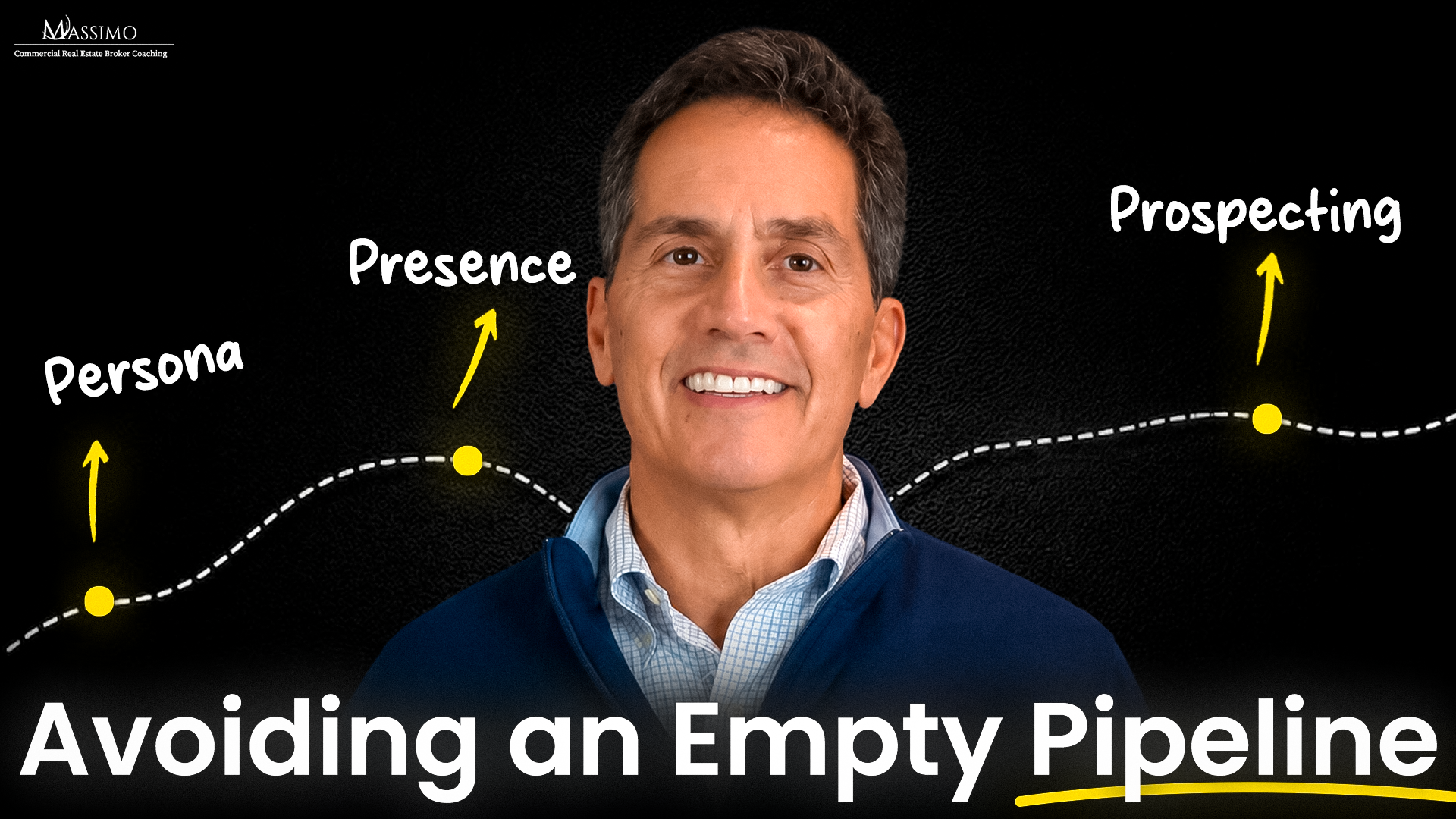
That system begins with three areas: persona, presence, and prospecting. Avoiding an empty pipeline_scri…
Start by Defining Exactly Who You Serve
A commercial real estate broker needs a clear answer to two questions:
Who do I serve?
How do I serve them?
Broad answers create broad messaging.
And broad messaging is easy to ignore.
A broker who says, “I work with office tenants,” may be technically accurate, but the positioning does very little to differentiate that broker.
Now narrow it.
Office tenants in a specific submarket.
Then narrow it again.
Office tenants above a certain size.
Then narrow further.
Perhaps law firms with specific occupancy, renewal, expansion, or relocation needs.
Now the broker is starting to look more like a specialist.
Rod’s point is that specificity changes far more than marketing copy. It changes who you pursue, what you say, the problems you discuss, and how the prospect perceives your relevance. Avoiding an empty pipeline_scri…
Your Positioning Also Depends on How You Serve
Defining the client is only half the equation.
A broker also needs to understand what makes the service relevant to that particular client.
Generic descriptions such as “I lease office space” or “I sell buildings” rarely communicate meaningful differentiation.
Experienced clients want to understand the value surrounding the transaction.
That might involve analysis, market intelligence, negotiation insight, location strategy, employee considerations, space optimization, or another form of expertise tied directly to the client’s situation.
The exact answer will vary by practice.
The important point is that the service should connect with the client’s actual goals, aspirations, fears, and frustrations.
The stronger that connection becomes, the more relevant your messaging becomes.
Presence Keeps You From Starting From Zero
Once you know who you serve, the next job is becoming known by those people.
Rod describes three forms of market presence: personal, physical, and digital. Avoiding an empty pipeline_scri…
Each serves a different purpose.
Personal Presence Builds Relationships
Personal presence includes the conversations and interactions that happen face to face.
One-on-one meetings.
Small events.
Industry organizations.
Conferences.
Association meetings.
These interactions tend to be high value because they create real relationships.
They are also limited by time.
You can only sit across the table from so many people in a week.
That makes personal presence powerful, but difficult to scale.
Physical Presence Helps You Stay Remembered
Physical communication has become unusual enough that it can stand out.
A useful market piece, a client story, relevant research, or another carefully chosen item can create a different type of impression from another email in an already crowded inbox.
The purpose is not simply sending material.
It is maintaining recognition among the people you most want to serve.
When the timing eventually becomes right, familiarity matters.
Digital Presence Creates Scale
Digital content allows a broker to remain visible to far more people than personal meetings alone could ever reach.
LinkedIn.
Video.
Email.
Market commentary.
Short-form content.
Long-form educational pieces.
These channels give experienced brokers a way to distribute what they know at scale.
The key is relevance.
The content should speak directly to the clients you defined earlier.
If your market cannot tell who the content is for, your positioning still needs work.
Presence Should Make Prospecting More Productive
Prospecting becomes significantly different when the person you contact already recognizes your name or perspective.
That is why presence and prospecting should not operate independently.
A prospect may have seen your content.
They may have received something from you.
They may have met you at an industry event.
Then the phone call arrives.
The interaction has context.
That is far more useful than treating every outreach attempt like a completely cold introduction.
Rod describes prospecting as the disciplined act of asking for business. The video also explains how that ask can be supported through multiple communication channels rather than relying on one isolated tactic. Avoiding an empty pipeline_scri…
The Pipeline System Has to Work While You Are Busy
This is the part that matters.
A pipeline system that only operates when you are slow is not really a system.
It is a reaction.
The goal is to maintain enough consistent activity that conversations continue even while major assignments demand your attention.
That does not necessarily mean you personally perform every activity every day.
It means the underlying system keeps moving.
Your market still sees you.
Your relationships still receive attention.
Prospects are still being contacted.
New conversations are still being created.
That is what reduces the painful reset that happens when a transaction suddenly ends.
How Do You Prevent a Dry Commercial Real Estate Pipeline?
Start by making the Find stage part of the business rather than something you return to whenever revenue slows down.
Know exactly who you serve.
Build consistent visibility among those people.
Then ask for the business through a coordinated prospecting process.
The objective is continuity.
You should not have to rebuild momentum from zero every time a deal closes.
The brokers who create more predictable pipelines are building systems that continue generating conversations while they are busy doing the work they have already won.
That is the discipline behind avoiding an empty pipeline.
To learn more about building a stronger commercial real estate brokerage business, contact the Massimo Group team.