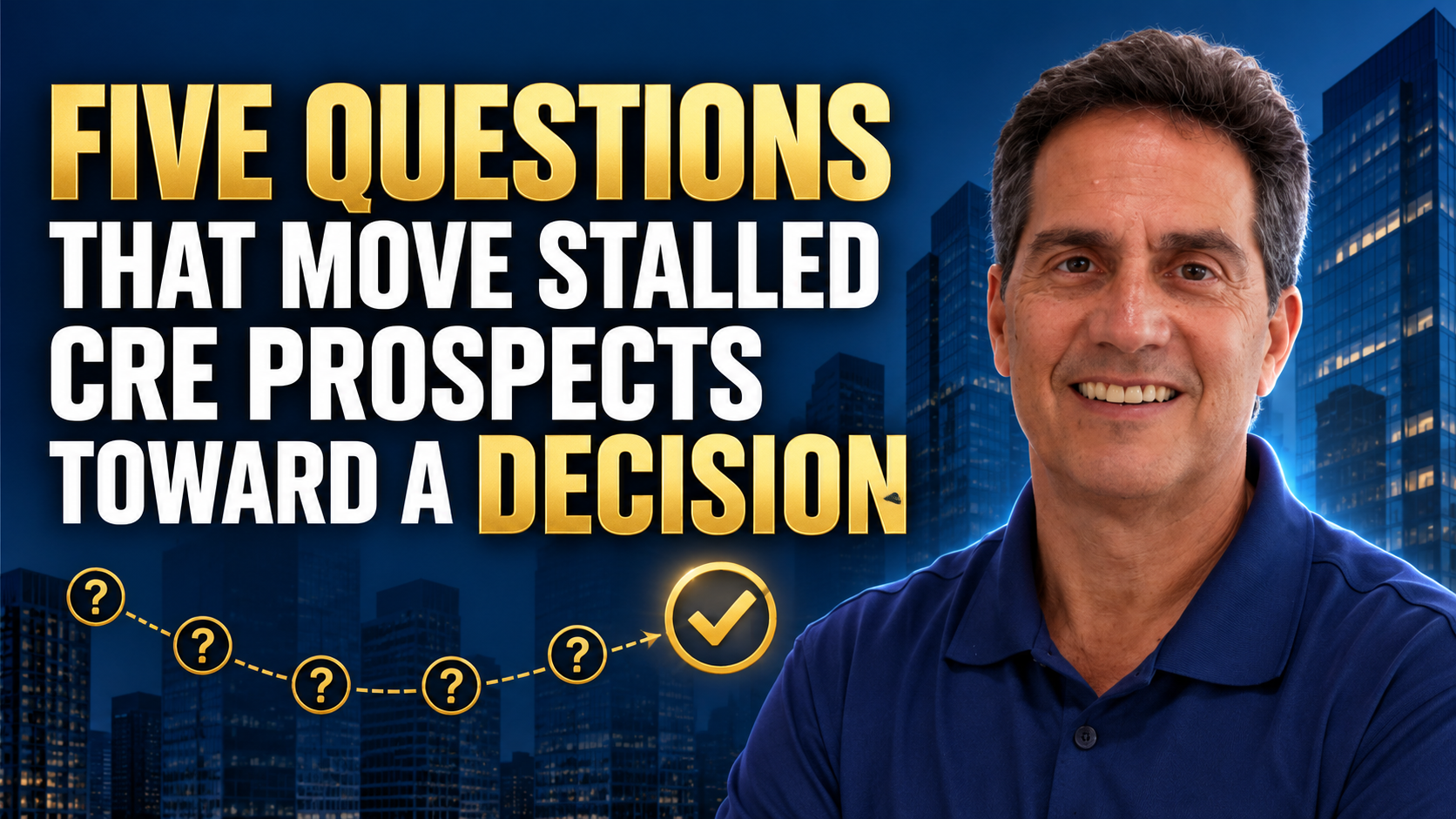
Five Questions That Move Stalled CRE Prospects Toward a Decision
You have a qualified commercial real estate prospect.
The conversation has gone well. You’ve established credibility, presented your thinking, and demonstrated that you understand the opportunity.
Then the prospect says something familiar.
“We need to think about it.”
“We’re not ready.”
“Your fee is too high.”
Suddenly, momentum disappears.
For experienced commercial real estate brokers, these moments can become expensive. A qualified opportunity sits in the pipeline, follow-up conversations multiply, and the likelihood of winning the assignment becomes harder to assess.
The quality of your next question can determine whether that opportunity moves toward a decision or remains stuck.
At Massimo Group, we work with commercial real estate brokers to strengthen the business-development conversations that create consistent opportunities and better outcomes.
One of the most important skills is knowing how to uncover what is preventing a qualified prospect from making a decision.
Why Do Commercial Real Estate Prospects Stall?
Commercial real estate prospects often stall because an important concern remains unresolved.
That concern may involve market timing, financial risk, competing priorities, internal disagreements, transaction complexity, or uncertainty about the value of professional representation.
A property owner may appear concerned about brokerage fees while actually questioning the scope of the engagement.
An investor may say the timing is wrong while struggling with a reinvestment decision.
An occupier may delay a leasing decision because the implications of relocating have not been fully considered.
Different situations require different conversations.
Yet brokers often respond with the same familiar activities.
Another market report.
Another set of comparable transactions.
Another revised proposal.
Another call scheduled for next week.
Those activities may be appropriate when they address an identified need. When the underlying concern remains unclear, they can simply extend the sales cycle.
The broker needs a better understanding of the decision standing in front of the prospect.
How Do You Move a Stalled CRE Prospect Forward?
Start with genuine curiosity and ask a question that helps clarify the prospect’s concern, evaluation criteria, or decision process.
That approach creates room for a more productive conversation.
Experienced brokers understand that a prospect’s initial objection may be a summary of a more complicated issue.
The objective is to understand what the prospect means and identify an appropriate next step.
Five questions can help guide those conversations.
Five Questions That Improve CRE Prospect Conversations
1. “Help Me Understand”
When a prospect makes a broad statement, this opening encourages clarification.
Consider the owner who says, “We’re just not ready.”
What does ready mean in that situation?
Are the ownership partners aligned? Is financial information missing? Has the owner’s investment strategy changed?
The broker who understands the reasoning behind the statement is better positioned to determine what the conversation needs next.
“Help me understand” invites explanation and encourages the prospect to describe the issue in their own words.
2. “Compared to What?”
Commercial real estate prospects frequently make judgments about fees, property values, market conditions, and proposed strategies.
Those judgments usually involve a comparison.
A fee may seem high relative to another proposal. An opinion of value may seem low relative to the owner’s expectations. Market conditions may appear unfavorable compared with an earlier transaction.
Understanding the benchmark helps the broker evaluate the concern more accurately.
That creates an opportunity to discuss the relevant differences and maintain a professional position.
3. “Tell Me More”
Prospects do not always explain the full concern in their first response.
A statement about market timing might involve investment objectives, taxes, partnership considerations, or uncertainty about what comes next.
Thoughtful follow-up questions can reveal details that affect the recommended course of action.
This requires patience.
The broker needs to listen, interpret the response, and create enough space for the prospect to explain what matters.
4. “Walk Me Through”
“I need to think about it” is one of the most common responses in commercial real estate.
It can also leave the next step undefined.
What does the prospect’s evaluation actually involve?
There may be additional decision-makers, missing information, competing priorities, or a defined internal approval process.
Understanding how the decision will be made helps the broker establish a more relevant follow-up conversation.
It also reduces the likelihood of relying on repeated check-ins that create activity without progress.
5. “What If Nothing Changes?”
Commercial real estate decisions often involve significant financial and operational consequences.
Waiting can be appropriate. Waiting can also create additional exposure.
An owner may face extended vacancy. An occupier may encounter space limitations. An investor may postpone an important portfolio decision.
Exploring the implications of continued inaction helps the prospect evaluate the available choices more completely.
The goal is an informed decision grounded in the prospect’s circumstances.
Why Better Questions Strengthen Your Brokerage Business
A stalled opportunity creates costs beyond the immediate assignment.
It consumes prospecting time.
It complicates pipeline forecasting.
It can distract attention from other qualified opportunities.
It may even weaken a broker’s positioning when the response is repeated price concessions or unnecessary persuasion.
A more disciplined discovery conversation creates clarity.
Sometimes that clarity leads to a new meeting, additional analysis, or a decision to engage.
Other times it leads to a clear decision to wait or move in another direction.
Both outcomes help a broker manage time, resources, and business-development priorities.
For established CRE professionals, the larger opportunity is to make productive client conversations a consistent part of the brokerage operation.
Build a More Consistent CRE Business-Development Process
Strong commercial real estate production depends on more than market expertise and established relationships.
It requires a disciplined approach to prospecting, discovery, positioning, presentations, and follow-up.
The five questions introduced in this training offer a useful starting point.
Their effectiveness depends on the context, the prospect’s response, and the broker’s ability to guide the conversation toward a meaningful decision.
The objective is to make each qualified prospect conversation more intentional, more productive, and easier to advance.
That level of consistency is developed through a structured business-development process.
Massimo Group works with commercial real estate professionals who want to strengthen that process and build a more predictable brokerage business.
For guidance on strengthening your prospecting, discovery, and follow-up systems, contact the Massimo Group team.